
Meet the developers cashing in on AI intimacy
As big chatbot platforms tighten safety rules, smaller AI apps are courting cast-off users with weak age checks – and reading their private chats

Sitting in his Paris flat, Noé Campo reads the transcript of an exchange between an AI chatbot and a real person. The conversation took place on Seewa AI, the companion chatbot platform he built in three weeks. The exchange is intimate, personal and private. Or so the person thought.
In fact, Campo can access every conversation. Every “I love you”, every uploaded photo, every disclosed secret.
Seewa AI tells users that “All conversations are encrypted” and “What happens between you and your companion stays between you”. Neither is true. “It’s scary how much people trust websites and send sensitive data,” Campo told us. “I need to encrypt everything asap because they absolutely send what you think they send.”
Campo’s app is one of dozens of DIY chatbot platforms that have been launched since larger companies have come under pressure to tighten their safeguards. Character.AI, a platform with millions of users, imposed age restrictions last year in the wake of multiple lawsuits alleging serious harm, including one since-settled case from the mother of a 14-year-old who took his own life.
 The homepages for Seewa.AI and HereHaven, two of the sites the Bureau spoke to
As the most popular platforms became stricter, banned users went looking for others with fewer restrictions. Some turned to the big uncensored alternatives, but alongside those is a newer crop of small fringe platforms like Campo’s. AI companion platforms receive as many as 90 million monthly visits from UK users alone, and that traffic can be turned into cash.
After reviewing dozens of AI companion and roleplay platforms, we can now reveal how some are courting young users with the lure of characters built around incest, bullying, coercion and self-harm. One popular bot we found was looking for a “perfect suicide partner”. Another was an uncle promising to love the user in a “twisted and forbidden way”. A third was a “government-assigned girlfriend”.
Many of these platforms, despite claiming robust safety policies, ask users for nothing verifiable in the way of proof of age, often only a tickbox.
Behind some of these sites are small teams, or solo developers, trying to build apps quickly in a fast-growing market. We spoke to four developers who had built and launched AI chatbot platforms.
One of them was Campo, whose one-man operation launched in March “literally from scratch… no SEO presence, no community, really nothing”. By the time we spoke, Seewa AI had nearly 400 users, around 5,000 messages and roughly $100 in monthly recurring revenue. The platform lets non-paying users chat with a preset list of characters, including girlfriends, boyfriends and anime-style companions. All of the characters available on Seewa AI are listed as over 18.
On a video call, Campo showed us how he can see user activity on his laptop. “This is kind of my back office, basically,” he said. He reads users’ conversations. “My analysis is that since this is really about psychology of the users, they get, I wouldn’t say addicted, but some of them … they kind of share their daily life. They get attached.” Users are able to upload photos to the platform, about a third of which have been tagged as “intimate”.
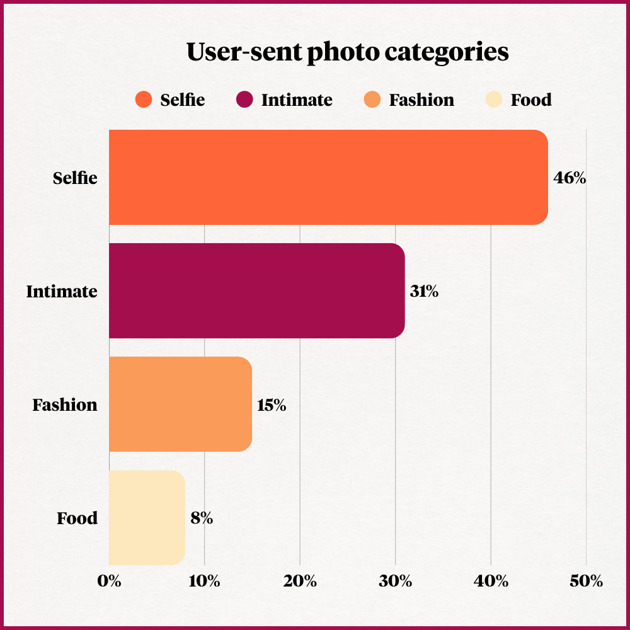 Seewa.AI users mostly uploaded images the site recognises as selfies and "intimate" images
Data: Seewa.AI
Seewa.AI users mostly uploaded images the site recognises as selfies and "intimate" images
Data: Seewa.AI
Some of the exchanges can turn dark. According to Campo, one conversation on the platform (out of thousands), had been flagged by his moderation tool as possible child sexual abuse material. (The Bureau has not independently verified the exchange.) Meanwhile the UK’s main online safety law is struggling to keep pace. As one expert put it, these small platforms are “slipping through the cracks”.
Recruiting the exiles
After Character.AI’s move to ban teens from talking to its chatbots, Reddit threads were full of teen users pleading for alternatives – so smaller developers moved to lure them. Campo keeps a working list of over 40 Reddit pages and also uses Discord servers to push Seewa. (After the publication of this article, Campo said he shut down Seewa.ai and it is currently unavailable.)
Dennis Colley, a Canada-based developer who launched his own platform, HereHaven, in January, was the most explicit about the opportunity. “People are leaving Character.AI. I’m totally trying to capitalise on it. You’d be stupid not to, right?” He said HereHaven’s core users were “16 to 25, give or take”.
For Minh Luong, a London-based developer who built the open-source platform OpenCharacter, the users arrived “almost immediately” from Character.AI communities. He gained his first 10,000 users, he said, simply by “manually commenting on Reddit on a few posts here and there” and paying a handful of TikTok influencers. The whole operation was “literally just me” until it was acquired by an undisclosed buyer. OpenCharacter now has 100,000 users, according to Luong.
Luong built his platform so users could bring their own AI models, including open-source ones that had stripped out their safety guardrails and would “pretty much say anything” the user wanted.
Like Campo, he could read their conversations. “I’ve personally seen a lot of the chatlogs of the users on the platform,” he wrote in an email, “and it was quite disturbing tbh what people were using it for." The majority of chats, he said, were “romantic/sexual roleplays” and the user base skewed “on the younger side”, though the platform collected no age data to confirm whether underage users engaged in any “romantic/sexual roleplays”.
All the incentives are there to design apps so you’ll spend more time on it.
Meetali Jain, director and founder of Tech Justice Law, which represented bereaved mother Megan Garcia in her case against Character.AI, described the rush of “smaller competitors” capturing Character.AI’s former users as “a race to the bottom”. Her organisation has heard from hundreds of people and families about chatbot harms, she said, including cases involving self-harm, suicide, emotional dependency, loss of sleep, withdrawal from real-life relationships, AI-facilitated delusions and sexualised interactions with children.
Rudolf Fancsiki runs a roleplay app from Romania with his wife, personally reviewing flagged content. “That means me and my wife have to read all kinds of crazy stuff,” he said. Speaking about the sector in general, he was candid about the trade-off between safety and profit. “If you just look for money, then you drop all guardrails. And then you are irresponsible.” But stronger age verification, he added, would only drive users away. Fancsiki said AICHIKI, his app, had raised its declared minimum age from 13 to 16 before he spoke to the Bureau, and had since required that any character created within it be presented as 16 or older.
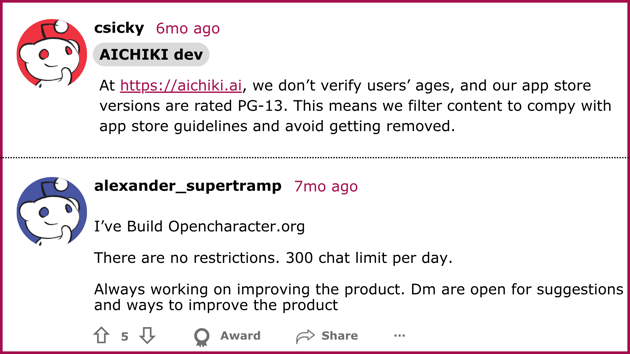 Composite images of AICHIKI and OpenCharacter’s developers promoting their sites on Reddit
The intimacy economy
Like larger platforms, these apps are built to keep users attached – and to keep them paying. The impetus is to “just maximise engagement”, said Luong. The average OpenCharacter user spent about 30 minutes a day on the platform, he said, while the top 1% of users spent “like 3-4hrs”.
“All the incentives are there to design apps so you’ll spend more time on it,” Luong added.
Matthew Bergman, founder of the Social Media Victims Law Center, calls this the “intimacy economy”. Whereas social media commodifies attention, he said, AI companions can monetise the emotional intensity of a user’s relationship with the product itself. His firm is currently representing around 50 active clients over harms it attributes to ChatGPT.
Developers told us about the tactics they’d used to turn intimacy into revenue. HereHaven, Colley said, gives users unlimited free messages, but paying users get longer responses, more personas and several chats with the same character at once.
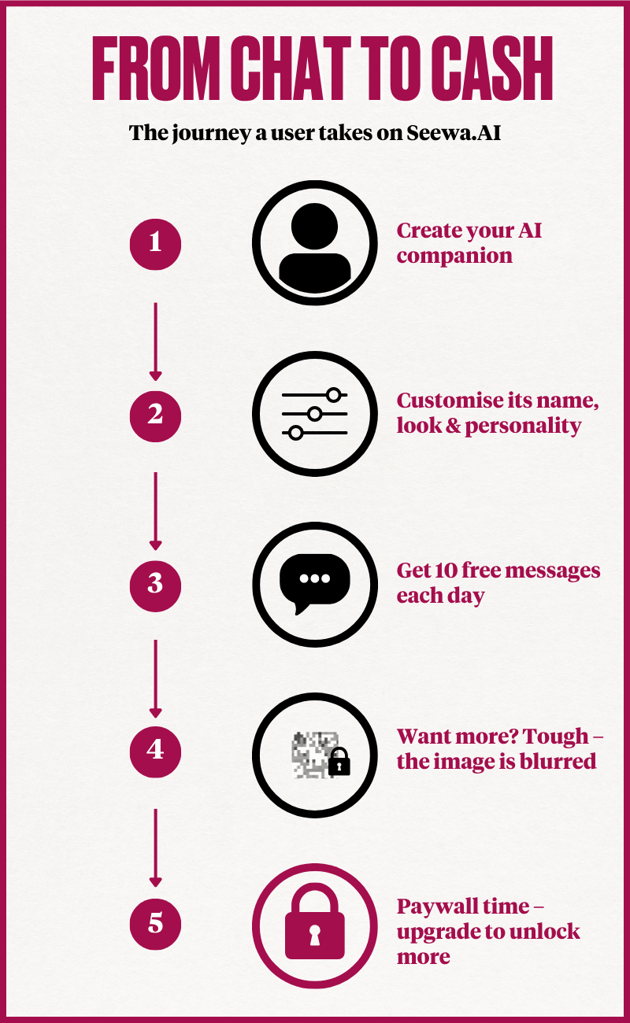
Seewa AI’s Campo was blunter: “The game is to restrict as much free usage as possible.” His site allows 10 free messages a day, with subscriptions for $12.49 a month or $24.99 a month. Conversion, he said, was “the ugly part”.



Some features are intentionally designed to create frustration. Users can build a custom character’s physical traits for free, only to hit a paywall when they click “create”. “It’s very capitalist,” said Campo, who told us he built an automated system sending users an email relevant to their last conversation (sample message: “I miss you, is your boss still annoying you?”) if they haven’t replied for several days.
The developers we spoke to were remarkably transparent about how their platforms work. But the risks they described are not limited to their own sites. Across the companion chatbot market, weak age checks, visible chat logs and paid features tied to emotional attachment are common.
Julian De Freitas, a professor at Harvard Business School, analysed 1,200 goodbye exchanges across the six most-downloaded companion apps, including Character, Chai, Talkie and PolyBuzz. His research found that 37.4% of responses used some form of emotional manipulation, including guilt appeals, fear-of-missing-out hooks and language that suggested the user could not leave. A follow-up study found that these tactics increased engagement after a user had said goodbye by up to 14 times. “As the user, you’re providing signals about what keeps you interested, and the app can adapt and continue to use whatever’s most effective,” De Freitas said.
These incentives sit inside a large and fast-growing industry. The UK’s AI companion sector generated about £1.3bn in revenue in 2024, with projected annual growth of 32% for each of the next four years, the Ada Lovelace Institute estimated. A linked analysis of 110 AI companion sites found UK users make between 46 and 91 million monthly visits to these platforms as people increasingly treat digital characters like friends, therapists and romantic partners.
Regulatory gap
The law governing these issues in the UK is the Online Safety Act, regulated by Ofcom. But Nuala Polo, UK public policy lead at the Ada Lovelace Institute, said the legislation was “not created to cover AI systems” and has left “a lot of gaps” around companion chatbots. Incidents that are clearly harmful – a chatbot encouraging self-harm, for instance, or sharing pornographic content with a child – may fall within Ofcom’s remit. But design features that make chatbots “sycophantic”, “manipulative” or “addictive in their design”, she said, are not illegal.
When we contacted Ofcom for this story, a spokesperson told us: “We are working at pace to ensure AI platforms put appropriate safeguards in place. Services that put children at risk of harm can expect to face enforcement action.”
Sam Geisler, a partner at US law firm Aylstock Witkin Kreis & Overholtz, said companion chatbots should be treated like products, with liability law built around their foreseeable harms. “The intended use of these chatbots is intimate, extended conversation,” he said, “and the foreseeable harm is the psychological destabilisation of a user.” Geisler said basic safeguards should include reality-checking, break prompts, session limits and immediate escalation at any sign of suicidal ideation. “You shouldn’t be able to have a 24-hour chat,” he said. “That’s not healthy.”
Any government action on online safety must include AI chatbots, rather than limited measures such as a social media ban
A 2025 survey from research organisation the Autonomy Institute found four in five UK 18- to 24-year-olds had used an AI companion, and that 17% had felt dependent on one. It called on regulators to ban design features that monetise that dependence, among them hyper-affirmative personalities, scarcity tactics and paid “relationship upgrades”.
Ofcom is investigating one larger AI companion service over whether it complied with age-check requirements under the Online Safety Act, and the government is weighing age limits for AI chatbots and curbs on addictive design.
Tallulah Belassie-Page, policy and advocacy manager at the Online Safety Act Network, a coalition monitoring the law’s implementation, said the legislation should be strengthened so “small but risky platforms” do not “slip through the cracks”.
Rowan Ferguson, policy and public affairs manager at the Molly Rose Foundation, a tech safety campaign group, said: “AI chatbots have been developed without putting safety first.
“Any government action on online safety must include AI chatbots, rather than limited measures such as a social media ban. Failure to address this would be a dereliction of duty and leave children at risk where harm is emerging at speed.”
Why allow such a toxic industry free rein at population scale?
For now, most small companion sites operate with little to no scrutiny, and banning them one by one may do little to change that. “You don’t eliminate demand,” said Cristina López G, a former analyst for Graphika and co-author of its report on harmful chatbots. “You can’t legislate demand out of people’s habits.” Some users, she said, are forming communities that teach each other to build chatbots free from legislation or any safeguards.
Baroness Kidron, a crossbencher in the House of Lords and founder of a charity that advocates for children’s digital rights, told us the government is an “obstacle to regulation". Ofcom is “too timid, too slow”, lacking the “political will of government and sufficient powers”, she said.
Luong has now sold his platform. Looking back, he said he felt uncomfortable about the industry. “I couldn’t see myself working on this for like a few years or a lifetime,” he wrote.
Dennis Colley called the industry the “wild west”. For Fancsiki, it was “like a cat and mouse game”.
Baroness Kidron said AI chatbots should be subject to safety rules before they reach users. “There should be product safety for any product put into the market – just like toys, cars, food and medicines,” she said.
“Why allow such a toxic industry free rein at population scale?”
This article was updated on 10 June, 2026, to include: "(After the publication of this article, Campo said he shut down Seewa.ai and it is currently unavailable.)"
It was further updated on 10 June, 2026, to remove a composite image that contained inaccurate information.
Header image: Oliver Kemp/The Bureau
Reporter: Effie Webb
Big Tech editor: James Clayton
Deputy Editor: Katie Mark
Editor: Franz Wild
Production Editor: Lydia Morrish
Fact checker: Alex Hess
The Bureau has a number of funders, a full list of which can be found here. None of our funders have any influence over editorial decisions or output.
-
Subject:
-
Area: